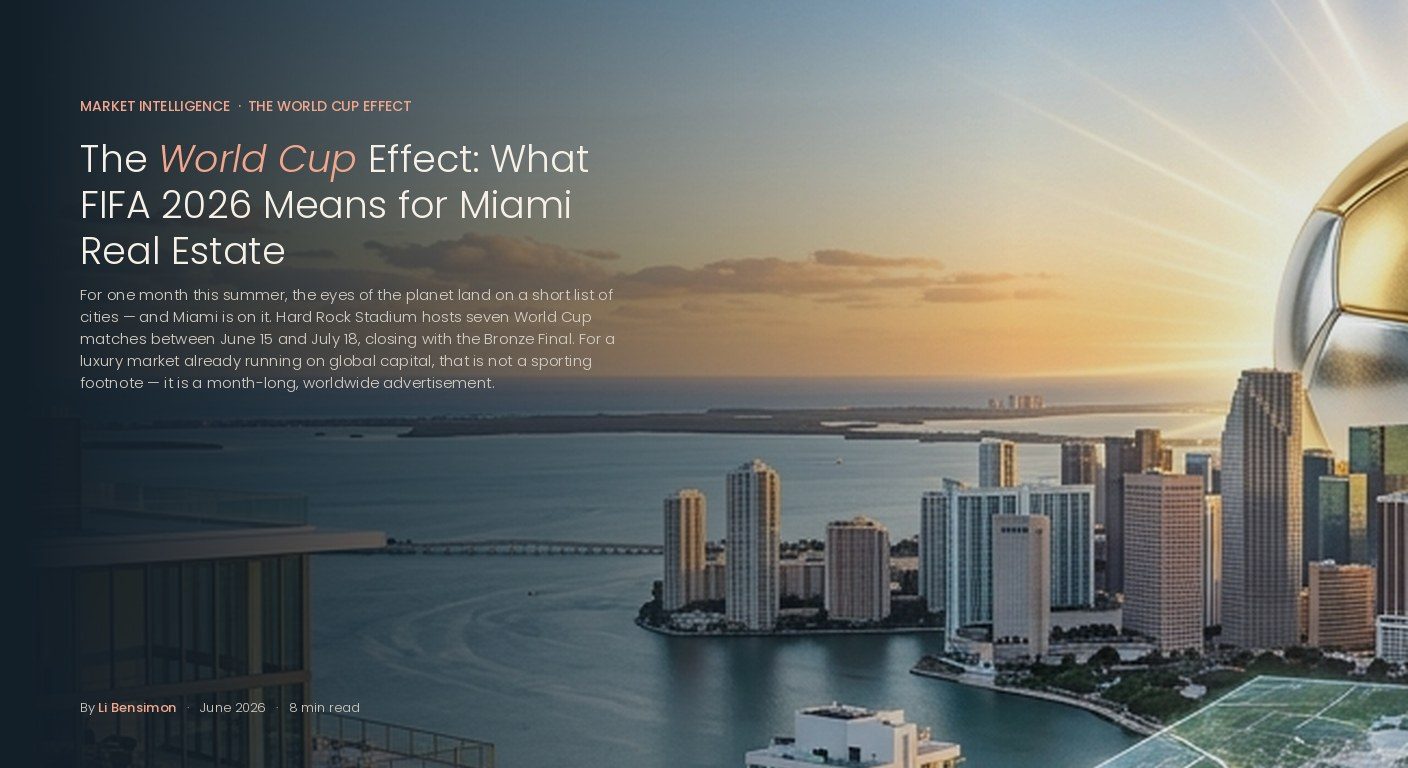
I get the question from clients in California, New York and São Paulo in almost the same words: does the World Cup actually move real estate, or is it noise? Here is the honest, data-grounded answer.
Between June 15 and July 18, Hard Rock Stadium in Miami Gardens hosts seven FIFA World Cup 2026 matches, four group-stage fixtures and three knockout games, closing with the Bronze Final on July 18. Brazil, Uruguay, Portugal and Colombia are all scheduled to play here. That lineup is not incidental: it concentrates high-net-worth visitors from precisely the regions that already drive Miami’s luxury demand.
Seven matches, a global, and deeply Latin, audience
Miami is already the primary destination for Latin American real estate investment in the United States. The World Cup brings that audience to the city in person, at scale, for a month. Four of South America’s most-followed national teams plus Portugal means tens of thousands of affluent visitors on the ground, the kind who tour a sales gallery between matches. In previous host cities, international buyer inquiries rose an estimated 15–25% around the tournament.
What history says about host cities
The event itself does not levitate an entire market overnight, host cities have historically seen average property appreciation of roughly 2.5% in the years around a tournament. But the luxury tier behaves differently. In the run-up to the Paris 2024 Olympics, prices in the city’s prime neighborhoods rose about 22%, and foreign interest in Paris luxury real estate surged more than 70%, led largely by American buyers. London’s Newham, home to the 2012 Olympic Village, saw values climb more than 400% over the following two decades, more than double the national average.
The deeper mechanism is infrastructure. Global tournaments compress years of transit, hospitality and redevelopment investment into a few accelerated years, stadium upgrades, the hotel pipeline, airport and roadway work. That spending outlasts the final whistle, and it tends to lift the neighborhoods around it.
Miami didn’t need the Cup, but it helps
Here is the part that matters most: Miami entered 2026 already in a structural boom. Pre-construction condos posted 12–18% year-over-year price appreciation in Q1 2026. South Florida recorded 361 closings above $10 million in 2025, one of the strongest years on record, and a single Indian Creek estate traded for roughly $170 million in the first quarter. Underneath it all sits the engine that never switches off: Florida has no state income tax, the structural reason high earners keep relocating from New York and California.
The World Cup does not create that demand. It pours a month of concentrated global attention onto a market that was already absorbing capital faster than it can build.
The clearest short-term signal: rentals
The most immediate, measurable effect is in short-term rentals. Demand for Miami stays on platforms like Airbnb has jumped roughly 159% versus the same period last year, making it the top-performing U.S. host market after the Mexican host cities. For the owner of a well-located, lock-and-leave residence, the tournament window is a genuine income event.
I would caution against buying for the spike alone, a month of premium nightly rates does not underwrite a multimillion-dollar purchase. But for a buyer already weighing a Miami pied-à-terre, the event sharpens an existing case rather than inventing a new one.
What it means if you’re buying
If your horizon is the next few years, the interesting math is in pre-construction. Today’s contracts price at today’s numbers and deliver in 2027–2028, historically with a 10–15% appreciation runway before keys, and that is before any World Cup halo. Branded residences and true waterfront have been the clearest stores of value through cycles. Edgewater, Brickell and the bayfront are where I am focusing buyers who want the upside without overpaying for the headline.
A tournament is a moment. A no-income-tax state with constrained waterfront supply is a decade. The Cup just makes the decade harder to ignore.
How I’d play it
The window that matters is the next six to twelve months, the stretch where global attention peaks and the best pre-construction lines are still releasing. If you are weighing Miami, this is the moment to get specific: the right building, the right line, the right entry price, before the headlines do the negotiating for the seller.
None of this is a promise of returns, real estate is cyclical and intensely local, and the figures above are historical and illustrative, not a forecast for any single property. But the direction of travel is hard to argue with. If you want a private, no-pressure read on where the value is right now, that is the conversation I have with Compass clients every day.
Recibo la pregunta de clientes en California, Nueva York y São Paulo casi con las mismas palabras: ¿el Mundial realmente mueve el mercado inmobiliario, o es ruido? Esta es la respuesta honesta, basada en datos.
Entre el 15 de junio y el 18 de julio, el Hard Rock Stadium en Miami Gardens acoge siete partidos del Mundial 2026, cuatro de fase de grupos y tres de eliminatorias, cerrando con el partido por el tercer puesto el 18 de julio. Brasil, Uruguay, Portugal y Colombia jugarán aquí. Esa programación no es casual: concentra visitantes de alto patrimonio justo de las regiones que ya impulsan la demanda de lujo en Miami.
Siete partidos, una audiencia global, y profundamente latina
Miami ya es el destino principal de inversión inmobiliaria latinoamericana en Estados Unidos. El Mundial trae a esa audiencia a la ciudad en persona, a escala, durante un mes. En ciudades anfitrionas anteriores, las consultas de compradores internacionales subieron un estimado de 15–25% alrededor del torneo.
Lo que la historia dice sobre las ciudades anfitrionas
El evento por sí solo no eleva todo un mercado de la noche a la mañana, las ciudades anfitrionas han visto históricamente una apreciación promedio de cerca del 2.5% en los años alrededor del torneo. Pero el segmento de lujo se comporta distinto. En la previa de los Juegos de París 2024, los precios en los barrios prime subieron alrededor del 22%, y el interés extranjero en el lujo parisino se disparó más del 70%, liderado por compradores estadounidenses. Newham, en Londres, sede de la Villa Olímpica 2012, vio sus valores subir más del 400% en las dos décadas siguientes.
El mecanismo de fondo es la infraestructura. Los torneos globales comprimen años de inversión en transporte, hospitalidad y redesarrollo en pocos años acelerados, y ese gasto sobrevive al pitido final.
Miami no necesitaba el Mundial, pero ayuda
Lo más importante: Miami entró a 2026 ya en un boom estructural. Los condominios en pre-construcción registraron 12–18% de apreciación interanual en el primer trimestre de 2026. El sur de Florida registró 361 cierres por encima de $10 millones en 2025, uno de los años más fuertes, y una sola finca en Indian Creek se vendió por unos $170 millones en el primer trimestre. Debajo de todo está el motor que nunca se apaga: Florida no tiene impuesto estatal sobre la renta, la razón estructural por la que los altos ingresos siguen mudándose desde Nueva York y California.
El Mundial no crea esa demanda. Vierte un mes de atención global concentrada sobre un mercado que ya absorbía capital más rápido de lo que puede construir.
La señal de corto plazo más clara: las rentas
El efecto más inmediato y medible está en las rentas de corto plazo. La demanda de estancias en Miami en plataformas como Airbnb subió cerca del 159% frente al mismo período del año pasado, convirtiéndola en el mercado anfitrión de EE.UU. de mejor desempeño después de las ciudades mexicanas. Para el dueño de una residencia bien ubicada, la ventana del torneo es un evento de ingresos real.
Pero no compraría solo por el pico, un mes de tarifas premium no financia una compra multimillonaria. Para quien ya evalúa un pied-à-terre en Miami, el evento agudiza un caso que ya existía.
Qué significa si vas a comprar
Si tu horizonte son los próximos años, la matemática interesante está en la pre-construcción. Los contratos de hoy se fijan a precios de hoy y entregan en 2027–2028, históricamente con un margen de apreciación del 10–15% antes de las llaves. Las residencias de marca y el verdadero frente al mar han sido los refugios de valor más claros a través de los ciclos. Edgewater, Brickell y la bahía son donde estoy enfocando a los compradores.
Un torneo es un momento. Un estado sin impuesto sobre la renta con oferta limitada frente al mar es una década. El Mundial solo hace que esa década sea más difícil de ignorar.
Cómo lo jugaría
La ventana que importa son los próximos seis a doce meses, cuando la atención global llega a su punto máximo y aún se liberan las mejores líneas de pre-construcción. Si estás evaluando Miami, este es el momento de ser específico: el edificio correcto, la línea correcta, el precio de entrada correcto.
Nada de esto es una promesa de rendimientos, el sector inmobiliario es cíclico y muy local, y las cifras anteriores son históricas e ilustrativas, no un pronóstico. Si quieres una lectura privada y sin presión de dónde está el valor ahora mismo, esa es la conversación que tengo con clientes de Compass todos los días.